A shipping container is one of the simplest products you’ll ever buy - and one of the easiest to get wrong. Buy the wrong size and you live with the regret for a decade. Buy the wrong condition and you either overpaid for cosmetic shine you didn’t need, or you underpaid for steel that leaks. This guide is built to get you to the right answer in one read.
We’ll cover the four sizes, the four condition grades, the full 16-cell price matrix, and a decision framework that maps your use case to the exact unit you should buy. If you already know what you want, skip to the price matrix in section 3 and the quote button at the bottom. If you’re starting from zero, work through it in order - it’s about a 12-minute read.
Where to start
Three questions decide everything else:
- What are you using it for? Storage, a workshop, a habitable build, or a business asset. The answer narrows your condition choices immediately.
- How much space do you have? Both the container footprint and the truck access to deliver it. An 8’ × 40’ container needs roughly 100’ of straight approach for a tilt-bed truck.
- What’s your budget? Not just the container - the delivered, site-prepped, ready-to-use total. A $950 As-Is shell can become a $2,400 project after delivery and pads; a $4,100 One-Trip is closer to all-in.
Hold those three answers in your head as you read the rest. By section 5 we’ll fold them into a single recommendation.
1. The 4 sizes
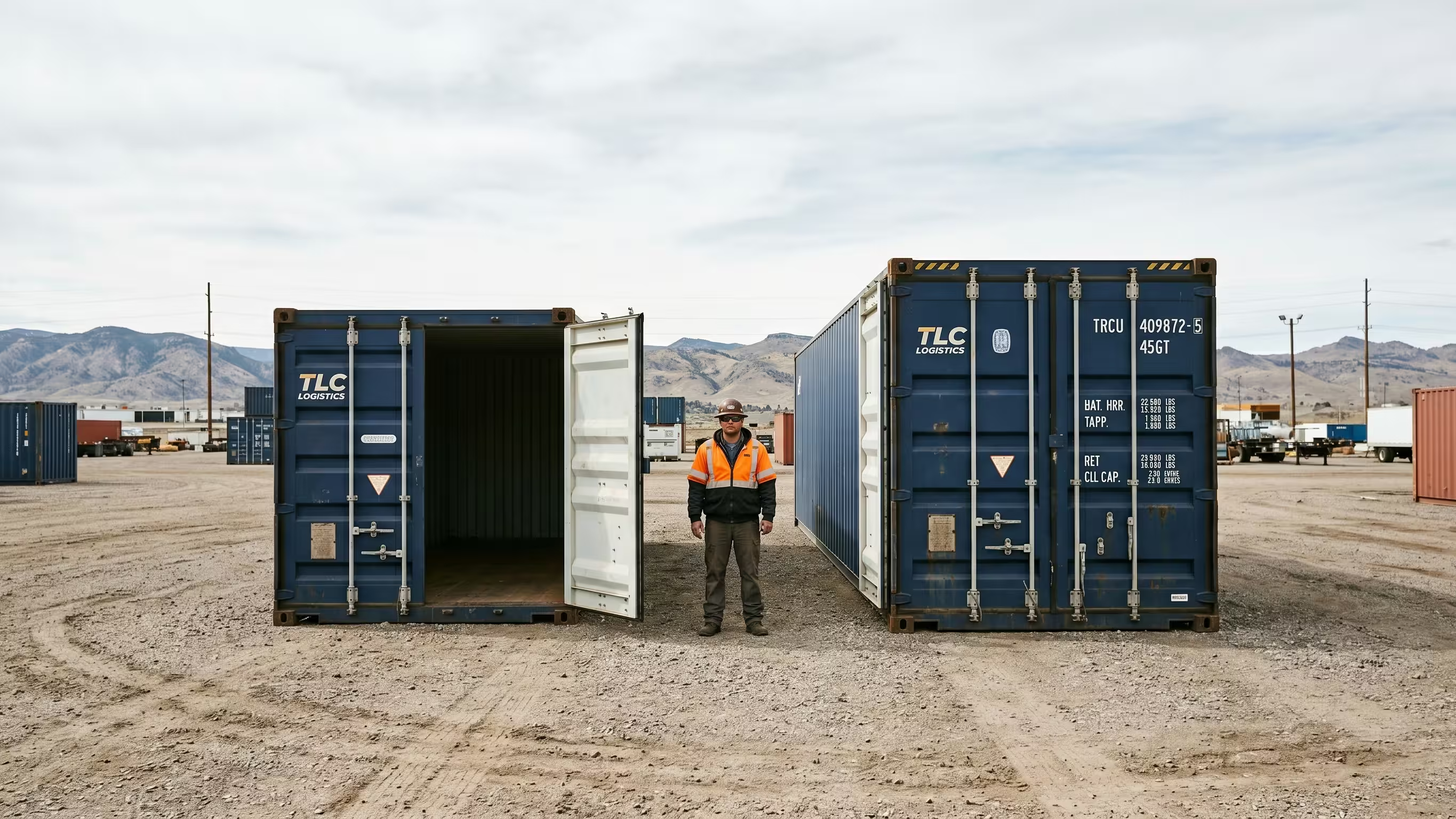
There are exactly four sizes you’ll ever see in residential and small-business container sales. (Specialty 10ft and 45ft units exist but are uncommon in the Front Range market.) The specifications below are pulled live from our yard inventory data - they’re the dimensions of the actual boxes we deliver.
The right size is rarely the largest. A 40ft is dramatically more useful than a 20ft for living and workshop builds; for pure storage, a 20ft is often the sweet spot because most residential lots and driveways can accommodate one easily. The full size comparison is in the spec table below.
A few rules of thumb:
- High Cube vs. Standard - High Cube adds 12 inches of interior height for $200–$350 more. Always worth it for habitable conversions; rarely worth it for pure storage.
- 20ft vs. 40ft - A 40ft costs less than two 20fts and uses less labor to deliver. If you have the space and the future use, 40ft is the better dollar-per-cubic-foot value.
- Door access - All four sizes have the same door opening on one end. If you need a second door or a roll-up, factor in $1,500–$3,500 in cutting and welding.
2. The 4 conditions
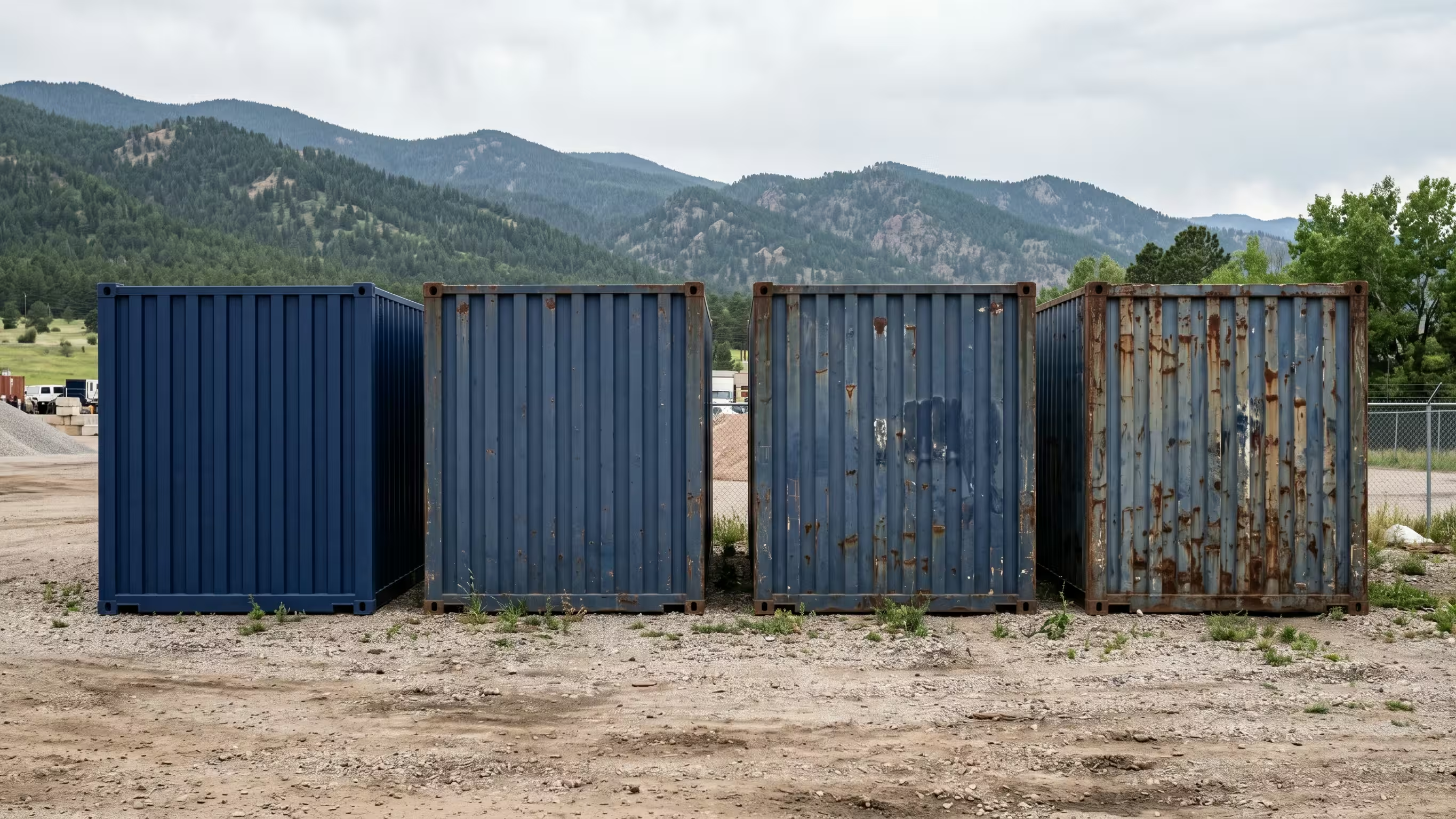
Container grading is the single area where buyers lose the most money - either overpaying for One-Trip cosmetic perfection they don’t need, or underpaying for As-Is steel that leaks on day one. The four grades on every reputable yard:
The detailed comparison below covers what each grade looks like, what it’s best used for, and the prep work you should expect. The price-tier indicators ($, $$, $$$) match the actual price matrix in section 3.
For 80% of residential storage buyers, Wind & Water Tight is the right answer. For 80% of workshop and ADU builders, Cargo Worthy is the right answer. One-Trip is for premium builds and customer-facing aesthetics. As-Is is for DIY-experts and salvage steel only.
3. Full price matrix
The price grid below is our actual Aurora yard pricing, refreshed against market. Every cell is delivered-ready stock at our yard in 80011 - delivery is quoted separately based on your ZIP. (Inside 25 miles, delivery is a flat $150.)
A few notes on reading it:
- Last digit is always 0 - we don’t play games with $1,247 anchoring.
- 40ft is always more than 20ft. High Cube is always more than Standard. One-Trip > CWO > WWT > As-Is. The pattern is consistent.
- The biggest single price gap is between Cargo Worthy and One-Trip - typically $1,300–$1,700 for the same footprint. That gap reflects age (CW units are 5–15 years old, One-Trip is 6–18 months) and cosmetic condition, not structural integrity.
4. How to choose
Three different decision paths get you to the same answer. Pick the one that matches how you think.
By use case
| Use case | Recommended config |
|---|---|
| Backyard storage (residential) | 20ft Standard, Wind & Water Tight - $1,200 |
| Garage overflow / contractor lockup | 20ft Standard, Cargo Worthy - $1,450 |
| Hobby workshop or maker space | 20ft High Cube, Cargo Worthy - $1,750 |
| Backyard office / studio | 20ft High Cube, One-Trip - $3,200 |
| ADU / tiny home / rental unit | 40ft High Cube, One-Trip - $4,100 |
| Mountain cabin shell (DIY) | 40ft High Cube, Cargo Worthy - $2,450 |
| Bulk equipment storage | 40ft Standard, Wind & Water Tight - $1,700 |
| Salvage steel / fence / wind break | 20ft As-Is - $950 |
By available space
If your delivery spot is tight, the container choice gets forced for you.
- Less than 25ft of clear length - you cannot accept a 40ft. Buy a 20ft.
- 25–45ft of clear length - 20ft is comfortable; 40ft is possible with careful staging.
- 45ft+ and a 100ft straight approach - a 40ft delivers cleanly and gives you twice the cubic footage for ~45% more dollars.
By budget
| Budget | What you get |
|---|---|
| Under $1,200 | 20ft As-Is - DIY salvage, rough storage, no warranty |
| $1,200–$1,700 | 20ft WWT or 40ft WWT - solid storage |
| $1,700–$2,500 | 20ft HC CW or 40ft CW - workshop-ready |
| $2,500–$3,500 | 20ft HC One-Trip or 40ft HC CW - premium storage or budget build |
| $3,500–$4,500 | 40ft HC One-Trip - turnkey habitable build |
| $4,500+ | Multiple units, custom modifications, or premium specs |
5. Decision flowchart
The flowchart in this section walks you from a single first question to a concrete recommendation in 3–4 clicks. (See the SVG diagram rendered by the page layout below.) The logic is the same as the use-case table above, but in tree form for visual thinkers.
6. Buying FAQ
The questions below are the ones we get most often from first-time buyers. Read the section above first - most of these are detailed cross-references.
7. Next step
You’ve read the guide. Three ways forward:
- Take the 60-second quiz - answer four questions, get a personalized recommendation with delivered pricing to your ZIP.
- Browse the catalog - see all 16 SKUs with full specs and current availability.
- Request a quote - tell us what you’re after and we’ll send a firm delivered price the same business day.
There’s no phone-call obligation, no high-pressure sales sequence. We’re a small Aurora yard and we’d rather you spent 10 minutes choosing the right container than 10 weeks regretting the wrong one.
| Size | External (L × W × H) | Internal (L × W × H) | Floor Area | Capacity | Tare |
|---|---|---|---|---|---|
| 20ft Standard | 20' × 8' × 8'6" | 19'4" × 7'8" × 7'10" | 146 sq ft | 1,172 cu ft | 5050 lb |
| 20ft High Cube | 20' × 8' × 9'6" | 19'4" × 7'8" × 8'10" | 146 sq ft | 1,326 cu ft | 5290 lb |
| 40ft Standard | 40' × 8' × 8'6" | 39'5" × 7'8" × 7'10" | 304 sq ft | 2,389 cu ft | 8160 lb |
| 40ft High Cube | 40' × 8' × 9'6" | 39'5" × 7'8" × 8'10" | 304 sq ft | 2,700 cu ft | 8775 lb |
| Condition | Age | Appearance | Best for | Tier |
|---|---|---|---|---|
| One-Trip | 6–18 months | Clean paint, dry floor, square doors, minimal scuffs. | Premium builds | $$$ |
| Cargo Worthy | 5–15 years | Working doors, dry floor, normal cosmetic wear and surface rust. | Best value for most projects | $$ |
| Wind & Water Tight | 15+ years | Visible service wear, more pronounced rust, doors still seal. | Budget builds | $ |
| As-Is | 18+ years | Dents, larger rust patches, possibly pinhole leaks. | DIY experts only | $ |
| Size \ Condition | One-Trip | Cargo Worthy | Wind & Water Tight | As-Is |
|---|---|---|---|---|
| 20ft Standard | $2800 | $1450 | $1200 | $950 |
| 20ft High Cube | $3200 | $1750 | $1450 | $1150 |
| 40ft Standard | $3800 | $2100 | $1700 | $1450 |
| 40ft High Cube | $4100 | $2450 | $2000 | $1700 |
Prices are for the container only, at our Aurora yard (80011). Delivery is quoted separately by ZIP. Inside 25 miles: flat $150.
Decision flowchart
Buying FAQ
Should I buy or rent a shipping container? ▾
What's the difference between 'used' and 'cargo worthy'? ▾
Do I need a permit in Aurora for a container? ▾
How much site prep does a container need? ▾
Will the container rust through? ▾
Can I cut windows and doors into a container? ▾
Why does delivery cost what it does? ▾
What's the resale value of a used container? ▾
Ready to pick a container?
Get a firm delivered price to your ZIP the same business day. Mon–Fri 8am–5pm MT.